Emergency Lighting Testing Auckland
Emergency lighting testing Auckland keeps your building’s lights and exit signs working when the power fails. This matters because tested systems guide people safely out during an evacuation.
French Electrical performs this testing to NZS 6742 across Auckland commercial and industrial buildings. As a result, you keep your systems working and your Building Warrant of Fitness (BWOF) current.
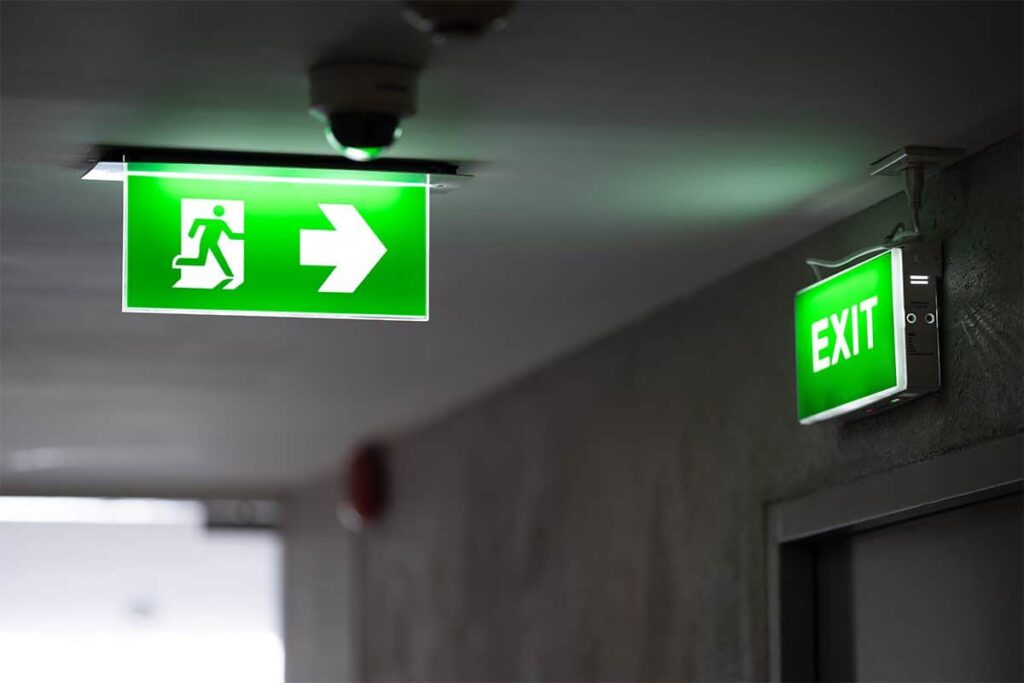
How Emergency Lighting Testing Auckland Works
We check every emergency light and exit sign in your building. Each one must activate correctly and run for its full rated duration. Once a year, we also run a full 90-minute discharge test to NZS 6742. As a result, you know your emergency lighting will perform for its full duration during a genuine power failure.
Between annual tests, a six-monthly functional check confirms each fitting switches to emergency mode correctly, without a full discharge.
Keeping Your BWOF Current
Emergency lighting is often a specified system on a building’s Compliance Schedule. Missed testing can put your Building Warrant of Fitness at risk. Because of this, we track your testing dates and contact you ahead of each deadline. So you never leave your emergency lighting testing Auckland compliance to chance.
Records You Can Rely On
Every test comes with a written record. It lists which fittings we tested, the results and any faults found. In addition, this record is ready for your BWOF file whenever you need it.
Emergency Lighting Testing
- Annual 90-minute full-duration discharge test to NZS 6742
- Six-monthly functional testing option
- Fault identification with clear repair recommendations
- Lamp and battery replacement carried out on-site where possible
- Test records maintained for your BWOF file

Get in Touch About Emergency Lighting Testing
Whether you need a one-off test or ongoing emergency lighting maintenance, our team is ready to help. Get in touch and we’ll confirm what your building’s Compliance Schedule requires.
What Each NZS 6742 Check Involves
NZS 6742 is the New Zealand Standard for emergency lighting testing. It sets out how often you must test your emergency lighting and what each test involves. This is the standard territorial authorities expect building owners to meet. You can read the full requirements in the Building Act 2004.The annual test runs each emergency light and exit sign on battery power. This checks the full rated duration, usually 90 minutes. As a result, you know each fitting will keep working for the whole time needed during a genuine evacuation.
The six-monthly check confirms each fitting switches correctly into emergency mode, without draining the battery through a full discharge. As a result, it’s a shorter test designed to catch problems between annual tests.
If a fitting fails during testing, we note the fault. Where possible, we carry out lamp and battery replacement plus minor repairs on-site. We also clearly flag anything requiring further work in your test report.





Emergency Lighting Testing FAQs
What happens if my emergency lighting fails a test?
We record the fault and, where possible, repair it on-site during the same visit. This might mean replacing lamps or batteries as needed. We also flag anything requiring further work clearly in your test report, so you can action it quickly.
How often does emergency lighting need to be tested?
NZS 6742 calls for an annual full-duration discharge test, with a six-monthly functional check in between. So, your building’s Compliance Schedule will confirm exactly what applies to your site.
Is emergency lighting testing a legal requirement?
Yes. Emergency lighting is commonly a specified system on a building’s Compliance Schedule. You must test it to NZS 6742 to keep your Building Warrant of Fitness (BWOF) current under the Building Act 2004.