The thing most people get wrong: it is not compulsory
Test and tag is widely described as a legal requirement in New Zealand. It is not, and WorkSafe says so directly.
What the law requires is that electrical equipment used at work is electrically safe and kept in a safe condition. Testing and tagging is one well-established way of demonstrating that you have met the duty — it is not the duty itself. AS/NZS 3760 is presented as an option for showing compliance, not as a mandate.
That distinction matters in both directions. It means nobody can tell you the law obliges you to buy a testing schedule. It also means you cannot discharge the obligation by doing nothing: if a worker is hurt by faulty equipment, “there is no legal requirement to test” is not a defence. The question will be what you did to know your equipment was safe.
Most businesses land on testing and tagging because it is the cheapest credible answer to that question, and because it produces a record.
Who is allowed to do it
The person doing the testing needs the relevant knowledge and skills, but they do not have to be a registered electrical worker. A business can train someone internally or bring in a third party.
There is a catch worth understanding before you decide. Only a registered electrical worker can carry out repairs on what the testing finds. So an in-house tester can identify a failed lead but cannot re-terminate it, which in practice means either items get thrown away rather than repaired, or you end up calling someone in anyway. For a small volume of equipment, in-house testing often costs more in scrapped gear than it saves in fees.
What has to be on the tag
A tag records who tested the item, the date it was tested, and when the next test is due. Some also carry an asset number so results can be tracked against the item over time.
Two practical points. A tag is a snapshot of the item’s condition on the day it was tested, and nothing more — it does not certify that the appliance is still safe six weeks later after somebody has run a trolley over the lead. And a missing or out-of-date tag is not itself a fault; it means the item’s status is unknown, which is why untagged gear generally gets pulled from service rather than trusted.
What test and tag does not cover
This is the gap that catches businesses out at audit. Test and tag applies to portable, plug-connected equipment. It says nothing about:
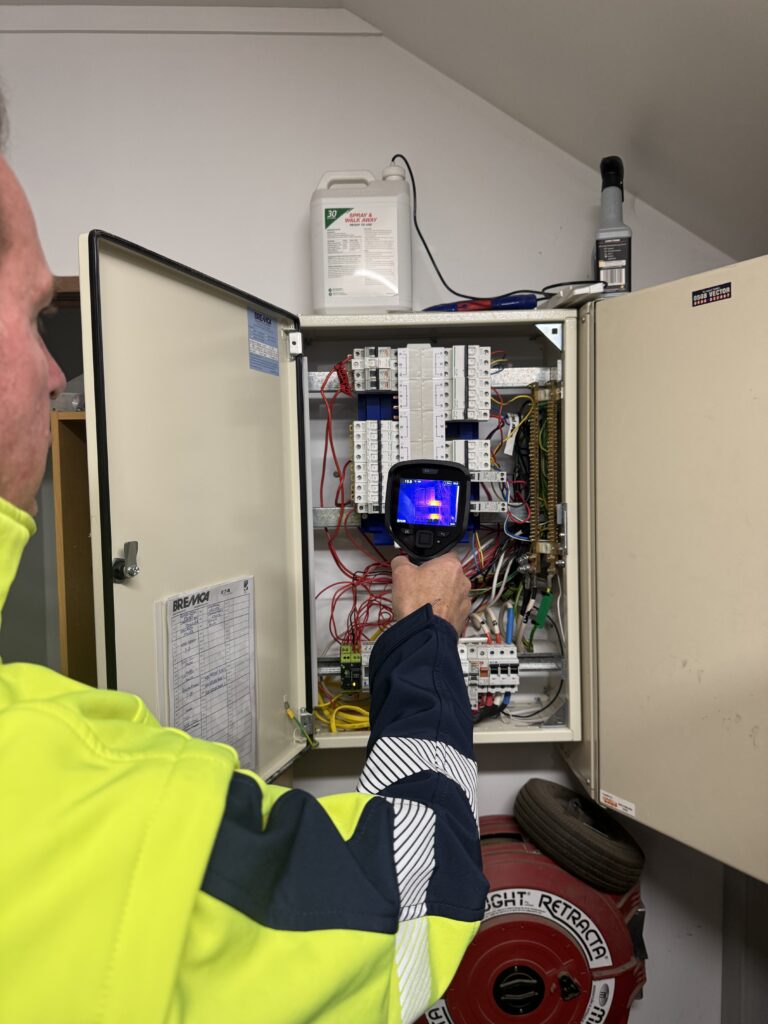
- Fixed wiring — switchboards, circuits, socket outlets, hard-wired equipment. That is inspection and testing of the installation, a separate exercise.
- RCDs. Equipment still needs RCD protection in the circumstances that call for it, such as outdoor and damp environments, regardless of whether it has been tested and tagged. RCDs need their own periodic testing.
- Specified systems — emergency lighting, fire alarms and the rest of a building warrant of fitness. Different regime entirely.
A tag on every extension lead and a switchboard nobody has opened in fifteen years is a common and misleading combination.
Making the schedule work
The intervals above are the standard’s recommendations, not a law, and the honest version is that they are a starting point you adjust to your site. Equipment that lives on a bench in a dry office is not the same risk as the same item on a wet site, and a hire fleet is different again.
What makes a programme actually useful rather than a box tick: keep a register so you know what you own and what is due; test new and repaired equipment before it goes into service; tag out failures immediately rather than leaving them in the cupboard; and look at the pattern, not just the pass rate. If the same lead type or the same brand of tool keeps failing, the fix is procurement, not more testing.
We provide test and tag as part of our commercial and industrial services, with records and reminders for when the next round is due. For the fixed side of the installation, see commercial electrical maintenance and compliance.
French Electrical is an Auckland electrician based in East Tamaki since 1974, covering homes and businesses across East and Central Auckland.