Short circuit, overload or earth fault?
All three trip a breaker, and telling them apart is most of the diagnosis. The behaviour is different in each case.
- Overload. The circuit is carrying more current than it’s rated for — a heater, a kettle and a dryer on the same run. The breaker trips after a short delay, and it usually holds again once you unplug something. Nothing is broken; the circuit is just being asked to do too much.
- Short circuit. Live touches neutral directly. Current spikes in an instant and the breaker trips immediately — the moment you reset it, or the moment the faulty appliance is switched on. There is no delay, and unplugging one heater won’t fix it.
- Earth fault. Live current is leaking to earth, through damaged insulation, damp, or a person. This is what the RCD is for, and an RCD trip is a different device from the breaker beside it. Earth faults are the ones that shock people, so an RCD that keeps tripping should never be ignored.
The practical shorthand: a delay before tripping usually means load; an instant trip usually means a fault; an RCD trip means current is going somewhere it shouldn’t.
Narrowing it down safely
There is a small amount of safe diagnosis you can do before calling anyone, and it saves time on the callout.
- Note which breaker tripped and what was running at the time.
- Unplug everything on that circuit, including whatever you were using when it went.
- Reset the breaker once. If it holds with nothing plugged in, the fault is in an appliance or a lead, not in the wiring.
- Plug items back in one at a time, leaving a moment between each. The one that trips it is your culprit — take it out of service.
- If the breaker won’t hold with everything unplugged, the fault is in the fixed wiring. Leave it off and call an electrician.
One reset is the limit. Repeatedly resetting a breaker onto a genuine fault lets it arc again each time, and each arc is heat at the fault point. That is how a short circuit becomes a fire. If it trips twice, stop.
What causes them in Auckland homes
- Rodents. Rats and mice chew cable insulation in ceiling and subfloor spaces. Common, invisible, and often the answer when a circuit starts tripping for no apparent reason.
- Water. A leaking roof, a blocked gutter or a perished seal on an outdoor fitting finding its way into a junction box. This is why faults so often appear after heavy rain.
- Damage during other work. A nail or screw through a cable during renovation, decking or shelving. The fault may not show up for months.
- Aged insulation. Rubber-insulated wiring from the mid-20th century goes brittle and crumbles, particularly where it has been warm.
- The appliance itself. A failed element, a damaged lead, water in a jug base. Usually the easiest to find, because it trips the moment that one thing is switched on.
How an electrician finds it
Finding a fault in fixed wiring is a measurement job rather than a hunt. Insulation resistance testing puts a test voltage across the wiring and measures whether current is leaking between conductors or to earth. That identifies which circuit is at fault and roughly how bad it is. From there the circuit is split at junction points to narrow the section down, and the physical fault is located and repaired.
If several circuits test poorly rather than one, that points at the age of the wiring generally rather than a single fault — a different conversation, about rewiring.
When a short circuit is really a switchboard problem
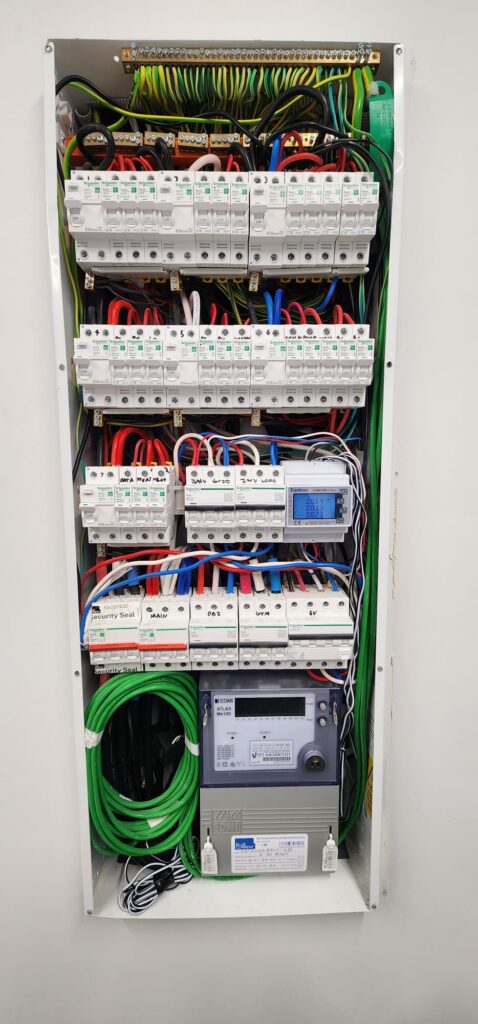
Old switchboards make faults harder to live with. Ceramic fuses tell you nothing about why they blew and tempt people into fitting heavier fuse wire. Boards without RCD protection leave earth faults undetected until someone gets a shock. And a board with only two or three circuits covering the whole house means one fault takes out half the lights.
If you are finding faults regularly, a switchboard upgrade often does more than chasing each one. For a check of the whole installation, an Electrical Warrant of Fitness tests circuits, RCDs, earthing and fittings and gives you a written record of what needs work. More on the warning signs worth acting on: power surges and home electrical safety.